By Bill Dries – Reporter, Daily Memphian
April 21, 2024
Fifty-five years after one of the darkest chapters in Memphis history, the unforgettable images of the 1968 sanitation workers’ strike are now preserved as stained-glass scenes in Clayborn Temple, a downtown church that served as a coordinating hub during the two-month action.
Artist Lonnie Robinson, who created the windows with Sharday Michelle, described a 2½-year process to bring the scenes to life as the historic church undergoes renovation and adaptive reuse.
“They really wanted to tell as much as they could in the stained-glass windows,” Robinson said.
To prepare, Robinson drew on his own Civil Rights Movement history books along with materials provided by Clayborn Temple.
The centerpiece of the west-facing window depicts marchers carrying “I Am A Man” signs—an enduring symbol of a strike that grew beyond labor issues into a broader fight for dignity and civil rights. The window faces Hernando Street, where strikers gathered daily in 1968 before marching to City Hall.
Robinson incorporated both recognizable faces from historical photos and additional details often overlooked. He learned, for example, that the “I Am A Man” signs were originally printed in red and white, a detail he made sure to include.
“I wanted them to be in a great perspective coming right out at the audience and really to include every kind of person,” he said.
The work also highlights the role of Black women in the movement. Robinson emphasized one central female marcher holding a sign reading “Keep your money in your pockets,” reflecting their often underrecognized contributions.
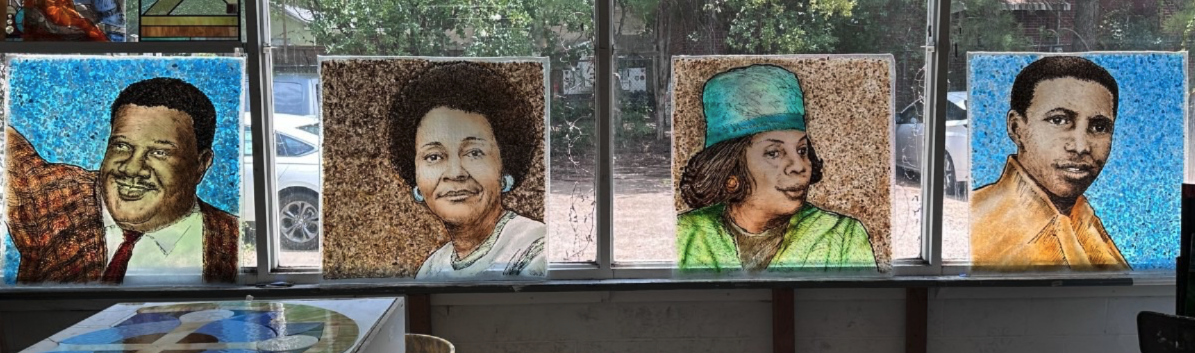
The stained-glass pieces incorporate fragments of the church’s original windows, which had been damaged over time. To match the vivid colors of the existing floral designs, Robinson and Michelle learned an infused-glass technique using powdered glass and frit for shading.
“We had to learn how to create the tones in the face using powdered glass,” Robinson said. “In order to create the lines, we used a bottle with a nozzle that squeezed glass in a paste form.”
The process required multiple repetitions because colors faded during firing. “You’re essentially doing that same process about three to four times,” he said. “It was a rigorous process to learn.”
While the technique was new to Robinson, the subject matter was not. He previously painted a large portrait of Martin Luther King Jr. for Memphis City Hall as part of the 50th anniversary of the strike and King’s assassination. In that work, he subtly incorporated the modern Memphis skyline within King’s eyes.
The stained-glass scenes at Clayborn Temple also depict a Black family, the sanitation workers’ barn where the strike began, and piles of garbage—visual reminders of the conditions that sparked the movement.
In addition, the windows feature portraits of local civil rights leaders, including Maxine Smith, a prominent NAACP leader in Memphis.
The church overlooks I Am A Man Plaza, a park created in 2018 that lists the names of the 1,300 sanitation workers involved in the strike and commemorates key moments of the movement, including King’s final “Mountaintop” speech.